
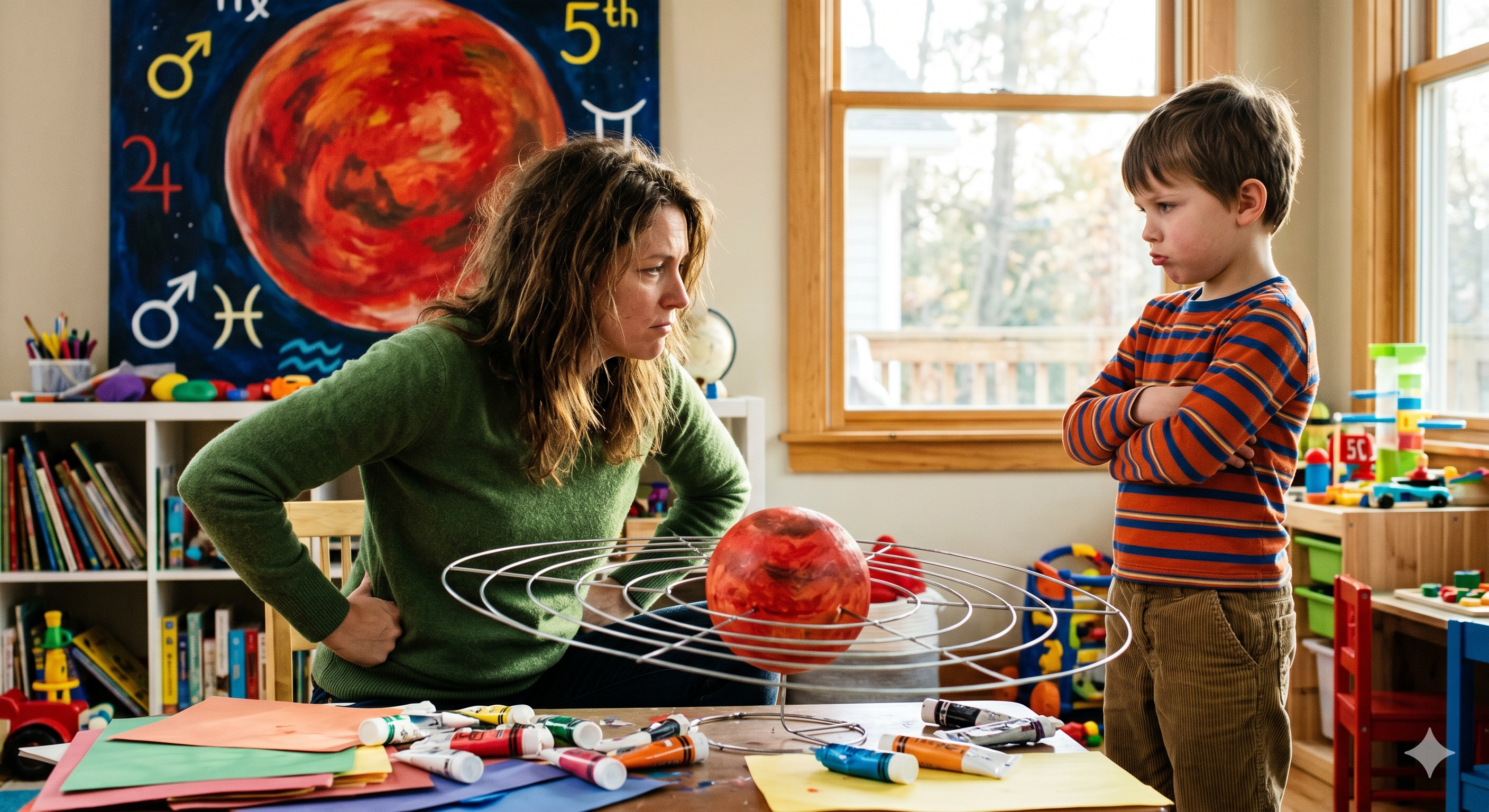

Mars in the 5th house raises a difficult question – When a child refuses your direction, what exactly is being challenged’? The child? Or the image you hold of yourself as a guide, protector, and authority?
The 5th house concerns children, creation, and legacy. Mars concerns will. It seeks action. It seeks influence. It seeks the power to shape outcomes. When these two meet, parenting often becomes a test of competing intentions.
The parent wants one thing. The child wants another.
Nothing unusual exists in this. Every generation experiences it. Yet Mars rarely views differences as neutral. It tends to see resistance where there is merely individuality. It sees opposition where there is simply another will seeking expression.
The ancient sages repeatedly questioned the urge to control. They observed that every being arrives with its own nature. Its own tendencies. Its own path of unfolding. The seed of a banyan does not become a mango tree through instruction. It becomes what it already contains.
Children are no different.
Yet the mind remains dissatisfied with this truth.
It wants participation. Then influence. Then authority. Finally, control. It believes wisdom grants ownership. It believes experience grants the right to decide another person’s direction.
Mars in the 5th house often exposes this assumption.
Many people with this placement genuinely wish to make their children strong. They value courage. Discipline. Endurance. Self-reliance. These are admirable qualities’. Yet a subtle confusion often appears. Strength is encouraged at first. Obedience is expected later.
The transition happens quietly.
The child begins making independent choices. The parent becomes uncomfortable. The child questions a rule. The parent becomes defensive. The child refuses a path. The parent interprets refusal as disrespect.
The issue is no longer the decision itself.
The issue becomes authority.
Who determines the direction? Who possesses the final word? Who yields? Who prevails?
The Upanishadic perspective would consider these questions secondary. The deeper issue is attachment. Not attachment to the child alone. Attachment to influence over the child.
Every attachment seeks continuity.
The ego wants its values preserved. Its worldview continued. Its methods validated. Therefore, the child gradually becomes more than a child. The child becomes a carrier of parental expectations.
This is where rivalry begins.
Not open hostility. Not visible conflict. A subtler form. The parent seeks compliance. The child seeks autonomy. The parent protects authority. The child protects individuality.
Both believe they are defending something important.
Perhaps they are.
Yet life itself favors neither side.
Life continually moves toward independence. The infant becomes the adolescent. The adolescent becomes the adult. Every stage involves separation. Every stage reduces parental control. This process is not a failure of parenting. It is the purpose of parenting.
Mars struggles with this reality.
It prefers action over acceptance. Intervention over observation. Direction over uncertainty. Therefore, it may continue pushing long after pushing is useful.
The result is predictable.
More force creates more resistance.
More control creates more distance.
More authority creates more rebellion.
The child is blamed. The real issue often remains unseen.
The issue is not disobedience.
The issue is possession.
The sages taught that nothing can truly be possessed. Not wealth. Not status. Not reputation. Not relationships. Certainly not another human being. A child may share your home. A child may carry your name. A child may inherit your teachings. Yet the child’s life remains their own.
Mars in the 5th house is ultimately asked to recognize this.
The lesson is not weakness. The lesson is restraint. Not withdrawal from responsibility, but withdrawal from ownership. Guidance remains necessary. Structure remains necessary. Discipline remains necessary. Possession is not.
A parent can offer direction without demanding agreement. They can share wisdom without requiring imitation. They can provide strength without expecting surrender.
This is a more difficult form of power.
It asks the parent to witness rather than command. To influence rather than control. To participate without claiming ownership of the outcome.
The child then becomes what every child was meant to become.
Not an extension of the parent.
Not a reflection of parental will.
But an individual expression of life itself.
Mars in the 5th house eventually discovers that the greatest victory is not winning against a child. It is overcoming the need to win at all.

Leave a Reply