
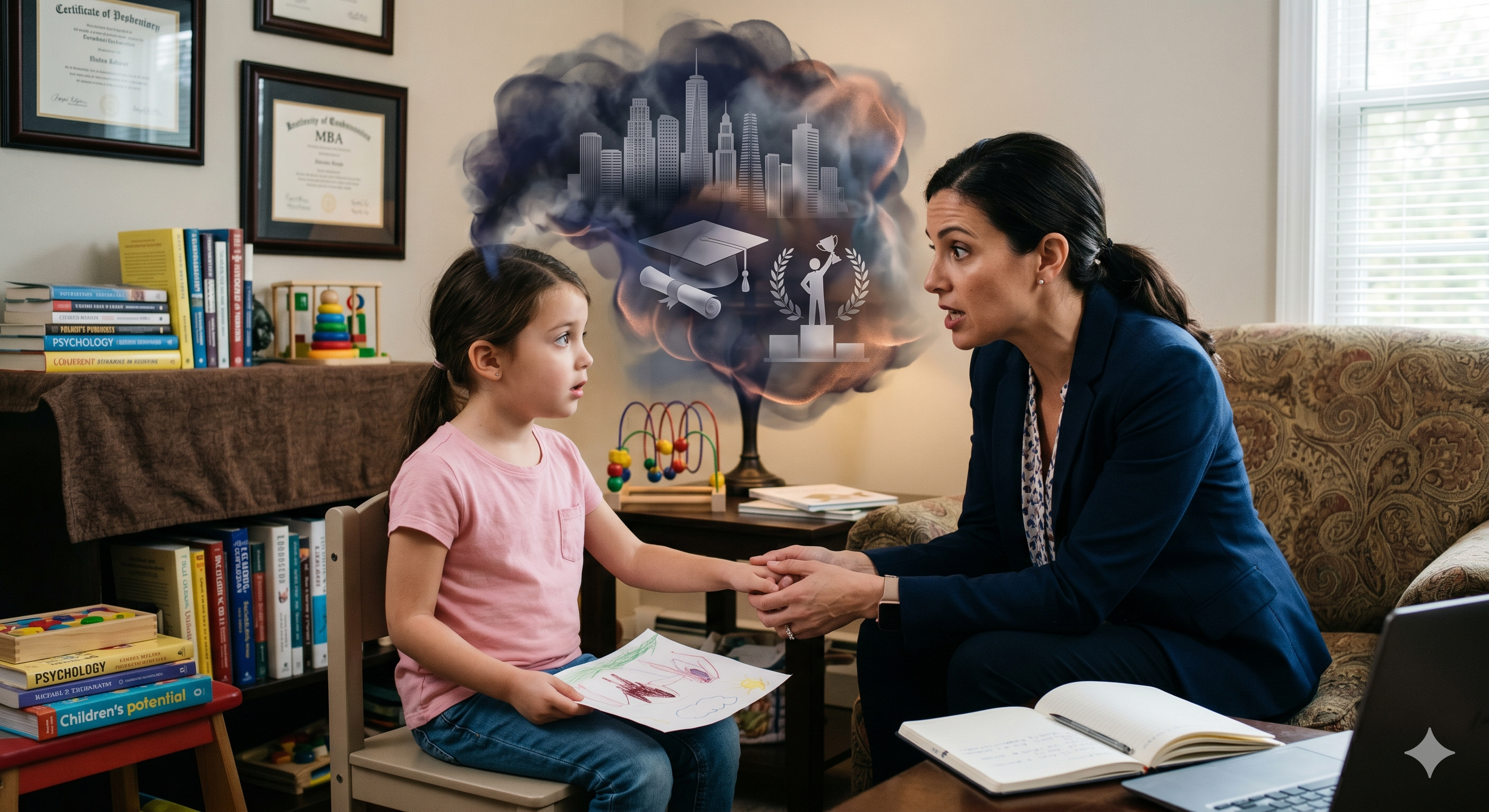

Rahu in the 5th house raises an uncomfortable question – When a parent speaks of a child’s future, whose desire is being discussed’? The child’s. Or the parent’s. The distinction appears simple. In practice, it rarely is.
The 5th house concerns children, creation, and legacy. Rahu concerns desire. Not ordinary desire. Desire that seeks fulfillment through expansion. Through achievement. Through becoming something more. Rahu is rarely satisfied with what exists. It constantly looks toward what could exist.
When this tendency enters the realm of children, an interesting pattern emerges. The child becomes connected to aspiration. To possibility. To imagined futures. The parent begins seeing not only the child, but also potential. Then more potential. Then an entire future constructed from that potential.
Nothing appears wrong initially. Encouragement is given. Opportunities are provided. Talents are developed. The parent believes they are helping the child grow. Society approves. Family members approve. Success appears to justify everything.
Yet the Upanishadic view would ask a different question. Who is choosing the destination?
A child expresses curiosity. The parent sees a career. A child displays ability. The parent sees distinction. A child enjoys an activity. The parent sees accomplishment. The actual experience gradually becomes less important than the imagined outcome.
This is how projection begins.
Not through force. Through identification.
The parent slowly attaches personal meaning to the child’s journey. The child’s achievements become emotionally significant. The child’s future becomes emotionally significant. The child’s choices become emotionally significant. The boundary separating two lives becomes unclear.
Rahu thrives in unclear boundaries.
The mind begins believing that another person’s success can complete something within itself. Unfulfilled ambitions remain active. Missed opportunities remain active. Desires once abandoned remain active. They seek expression through a different vehicle.
Often that vehicle becomes the child.
The parent may call this inspiration. The child may experience expectation. The parent may call it support. The child may experience pressure. Neither interpretation is entirely false.
The deeper issue lies elsewhere.
The Upanishads repeatedly challenge the idea that fulfillment can be obtained through external outcomes. Yet Rahu continually pursues fulfillment through outcomes. Through recognition. Through achievement. Through becoming.
Children easily become part of that pursuit.
As a result, the child may begin carrying burdens that do not belong to them’. Not material burdens. Psychological burdens. The burden of expectation. The burden of potential. The burden of representing a dream that originated before they were born.
This creates a subtle rivalry.
Not competition in the ordinary sense. A struggle over ownership of the future. The child seeks self-discovery. The parent seeks realization of a vision. The child asks what feels meaningful. The parent asks what seems promising.
The two questions are not always compatible.
As children mature, this difference becomes difficult to ignore. They develop independent interests. Independent values. Independent definitions of success. The parent becomes uncomfortable. Not necessarily because the child is wrong. Because the child is moving beyond the imagined script.
Rahu finds such moments unsettling.
It prefers movement toward a desired outcome. It prefers expansion according to expectation. It prefers visible accomplishment. Acceptance of uncertainty does not come naturally to it.
Yet uncertainty is precisely what life contains.
The sages understood that every individual arrives with a distinct nature. A distinct unfolding. A distinct path. One person cannot complete another person’s journey. One person cannot live another person’s destiny. Even a parent cannot do this for a child.
The confusion begins when guidance becomes ownership.
The child becomes a project. A mission. A continuation of personal ambition. The actual individual slowly disappears beneath expectation.
This is the lesson Rahu in the 5th house eventually encounters.
Children are not extensions of parental desire. They are not instruments of legacy. They are not solutions to unfinished ambitions. They are independent expressions of life itself.
A parent may provide support. They may provide opportunity. They may provide wisdom. Beyond that, control becomes illusion.
The highest understanding of this placement comes when ambition loses its claim over another person’s future. The parent continues to encourage. Continues to guide. Continues to care. Yet no longer demands that fulfillment arrive through the child’s choices.
Then something changes.
The child gains freedom. The parent gains clarity. The relationship loses its hidden burden.
And the question becomes easier to answer.
The dream belongs to the child. Not because the parent stopped caring. Because the parent finally stopped claiming ownership of what was never theirs.
Leave a Reply