
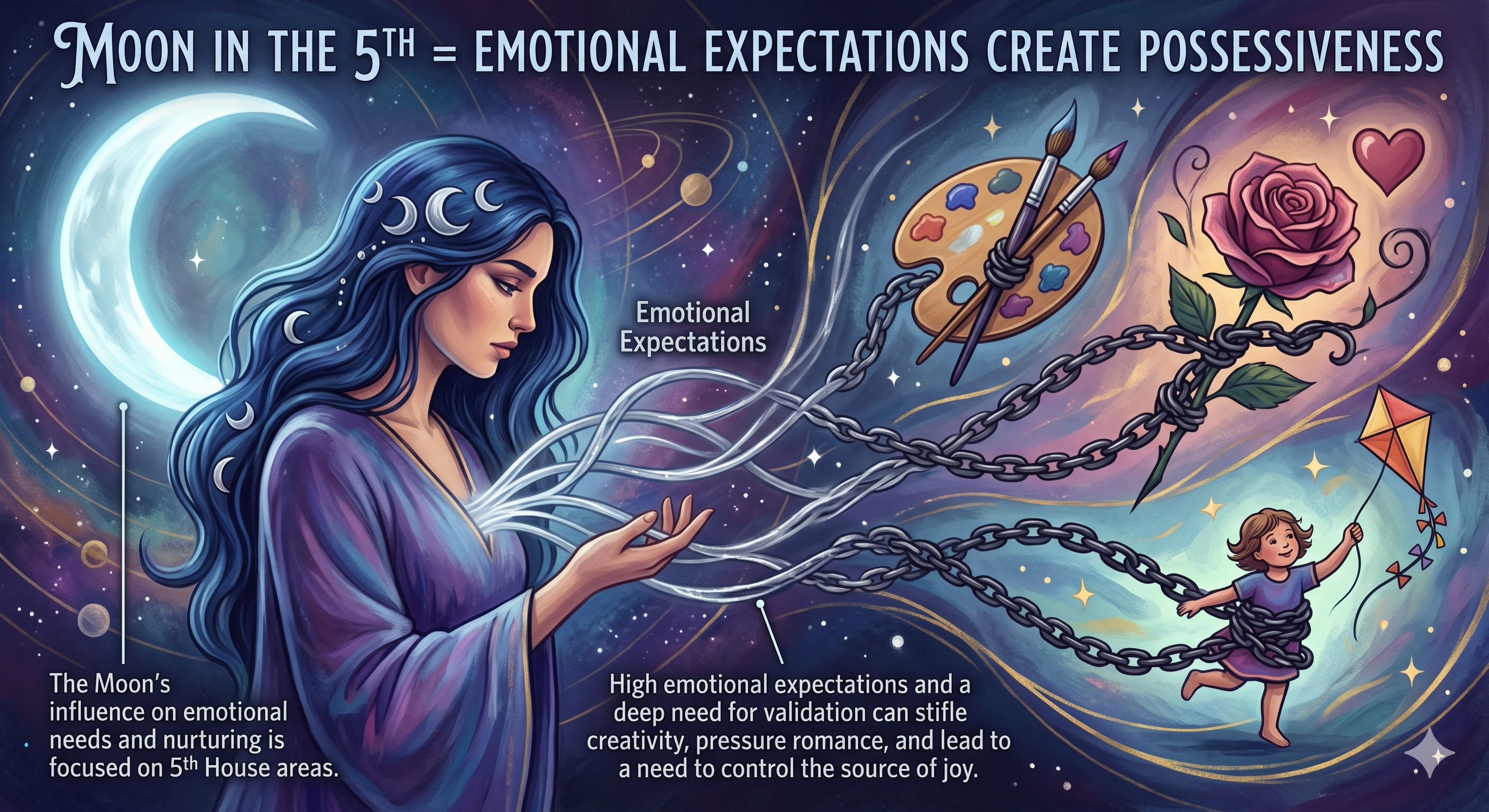

Moon in the 5th house places attachment near the child. Affection becomes strong. Concern becomes constant. The child occupies the mind. Not only as family. Also as emotional significance.
The child smiles. The parent feels fulfilled.
The child withdraws. The parent feels disturbed.
This appears natural. Yet the Upanishadic view asks a different question. Why should another person’s actions determine your inner state? What exactly is being protected? What exactly is being sought?
The Moon seeks security.
It seeks familiarity. It seeks continuity. It seeks emotional reassurance. In the 5th house, these tendencies often gather around children. The child becomes a source of comfort. A source of meaning. A source of emotional stability.
The attachment grows gradually.
Rarely through intention. Rarely through awareness.
The parent believes they are loving. Often they are. Yet love and attachment are not identical. The mind frequently confuses them.
The difference becomes visible later.
Every child moves outward. This is unavoidable. They develop preferences. Form friendships. Create private worlds. Make independent choices. Life pulls them toward themselves.
The parent experiences resistance.
Not always externally. Often internally.
A phone call arrives less often. Advice is requested less often. Time is spent elsewhere. The child is simply growing. Yet the parent interprets change as distance.
Distance becomes discomfort.
The discomfort becomes expectation.
The expectation becomes possessiveness.
Possessiveness rarely announces itself. It appears quietly. Through disappointment. Through emotional reactions. Through the need for reassurance. Through subtle demands for closeness.
The child notices.
They begin managing emotions. Not their own. Someone else’s. They become careful. They become responsible. They become aware of invisible expectations.
This is where confusion begins.
The parent believes they are nurturing. Yet part of them seeks confirmation. Confirmation that they remain important. Needed. Central.
The child becomes a mirror.
Not of love. Of identity.
The Upanishads repeatedly question identity itself. They ask what remains when all attachments disappear. What remains when roles disappear. When names disappear. When relationships change.
The inquiry is uncomfortable.
Many people discover that emotional dependence was hidden beneath affection. The child was expected to provide meaning. Provide purpose. Provide emotional continuity.
No child can carry this burden.
Nor should they.
Every individual arrives with their own path. Their own karma. Their own unfolding. A child is not an extension of the parent. They are not responsible for preserving the parent’s emotional world.
Yet the mind resists this truth.
It wants permanence. It wants closeness without change. It wants relationships frozen in familiar forms.
Life offers neither.
Everything changes. Every bond changes. Every role changes. Childhood changes.
The Moon struggles with this movement.
It remembers what was. It clings to what felt secure. It measures the present against the past.
The result is suffering.
Not because the child changed. Because attachment remained.
The sages would ask another question. Is your love dependent upon response? Upon attention? Upon emotional return? If the answer is yes, attachment has entered the relationship.
Attachment always seeks something back.
Love does not.
Love allows growth. Attachment fears growth. Love allows distance. Attachment fears distance. Love supports becoming. Attachment prefers possession.
The distinction is important.
Many parents believe sacrifice alone creates purity. Yet sacrifice can also hide expectation. Care can hide ownership. Protection can hide dependency.
The child exposes these realities.
Not intentionally. Simply by becoming themselves.
That is their function.
To grow beyond the image held by others.
Moon in the 5th house ultimately reveals a difficult lesson’. Emotional fulfillment cannot be outsourced’. Not to a child. Not to a relationship. Not to any external bond.
What depends on another remains unstable.
What depends on the Self remains untouched.
Once this becomes clear, possessiveness weakens. Expectations soften. The child is allowed freedom. The parent regains inner balance.
Nothing is lost.
The child continues growing.
The parent continues loving.
But the need to possess disappears.
Only the relationship remains.
And that is enough.
Leave a Reply