
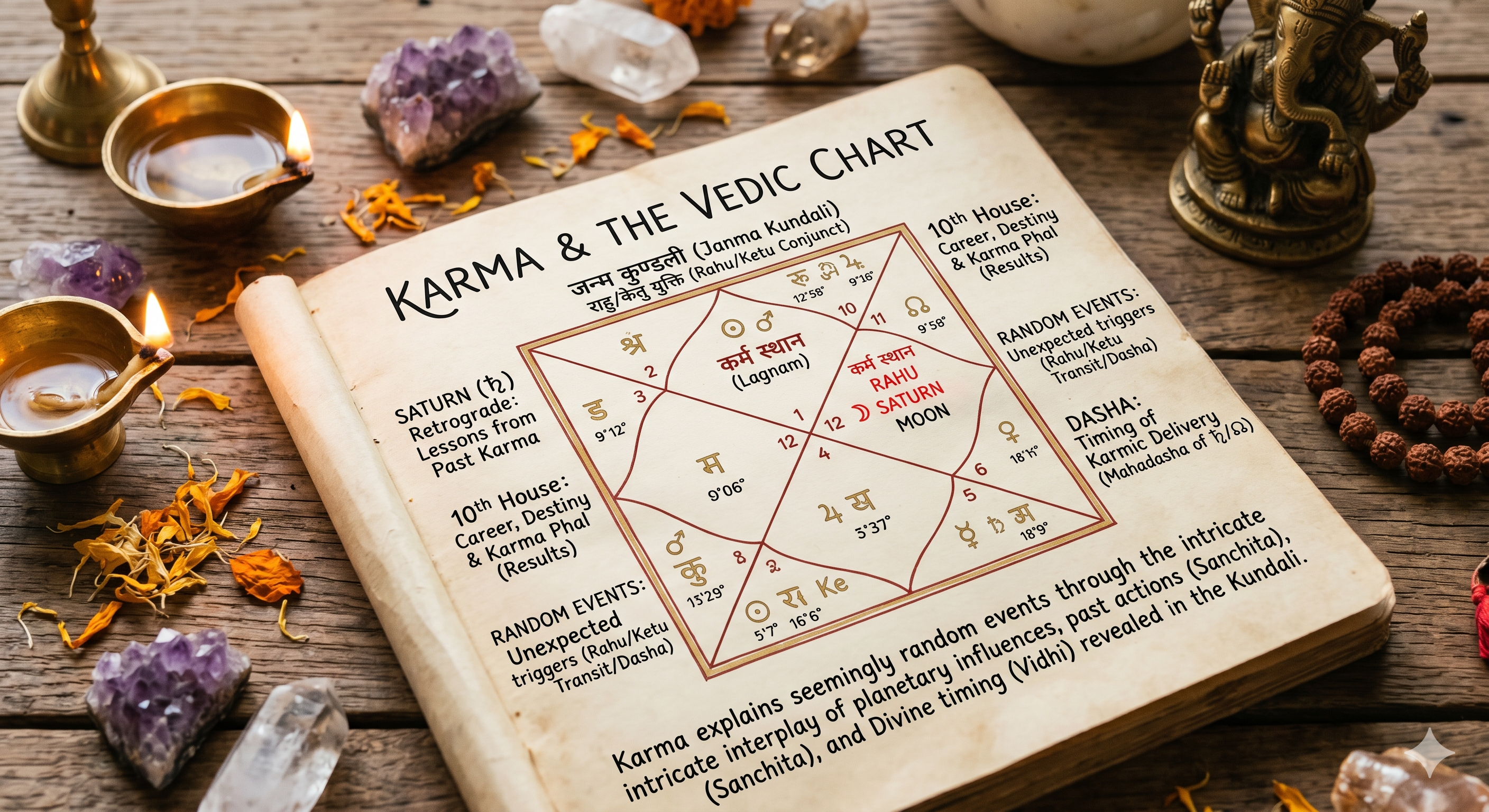

Something happens. Something unexpected. People immediately call it chance. Because, of course, admitting ignorance is easier than admitting limits.
A promotion arrives without warning. A loss arrives without explanation. A relationship appears, then collapses, as if it had no respect for your schedule. The mind labels all this as “random.” It sounds neat. It also sounds lazy.
The Upanishadic question does not bother with comfort. It simply asks: random according to whom? According to which level of perception?
The senses are poor witnesses. They record fragments. Never the whole sequence. So what we call randomness may just be incomplete observation wearing a sophisticated name.
Karma enters here, not as a moral accountant, but as a basic idea of continuity.
Action leaves residue. Cause leaves direction. Effect follows, sometimes immediately, sometimes after long delays that make the connection unrecognizable. The ego then declares: “coincidence.” A convenient verdict, delivered without investigation.
Nothing in this model requires cosmic justice. That is later storytelling. Karma, in its older philosophical sense, is indifferent. It does not care how you feel about the result’.
Vedic astrology, or Jyotisha, tries to read this indifference in symbolic form’.
It does not “predict” in the dramatic sense modern audiences prefer. It observes timing. It maps tendencies. It attempts to describe when certain patterns of consequence are more likely to surface. Not why life behaves this way—just when it does.
The birth chart is treated less like a prophecy and more like a snapshot of conditions. Not destiny carved in stone. More like weather patterns. You still get wet either way.
Planets are not decision-makers. They are indicators. Ancient markers of rhythm. Whether that rhythm has meaning is a separate argument, usually louder than the data itself.
Then come Rahu and Ketu. The usual suspects in every karmic explanation.
Ketu is called the residue of what is already understood. Rahu is the appetite for what is not. Together they describe a kind of psychological imbalance stretched across time. Or at least that is one interpretation. Others prefer simpler explanations, like “life is messy.”
The irony is that people only remember astrology when something goes wrong or suspiciously right. The middle of life remains astrologically irrelevant.
Still, the system claims timing matters. Certain periods activate certain outcomes. Life appears segmented into phases that feel meaningful only in hindsight. During the experience, everything still feels like improvisation.
Upanishadic thought refuses to romanticize this.
It does not say life is guided. It does not say life is random either. It leaves both claims hanging, slightly unresolved, like unfinished logic.
Free will is not denied. It is reduced to response. You do not choose the situation. You choose the reaction. That small gap is where philosophy hides its seriousness.
One person meets failure and builds clarity. Another meets the same failure and builds bitterness. The event is identical. The outcome is not. Karma continues either way, indifferent to interpretation.
So the question is not whether karma explains everything. That would be childish certainty in a more elegant costume.
The question is simpler. Do you actually know enough to call anything random?
Probably not. But people usually prefer certainty over accuracy. It is faster. It feels safer.
The Upanishads would likely say nothing at this point. Or say too much in too few words. Either way, the silence would be more informative than most explanations.
Leave a Reply