
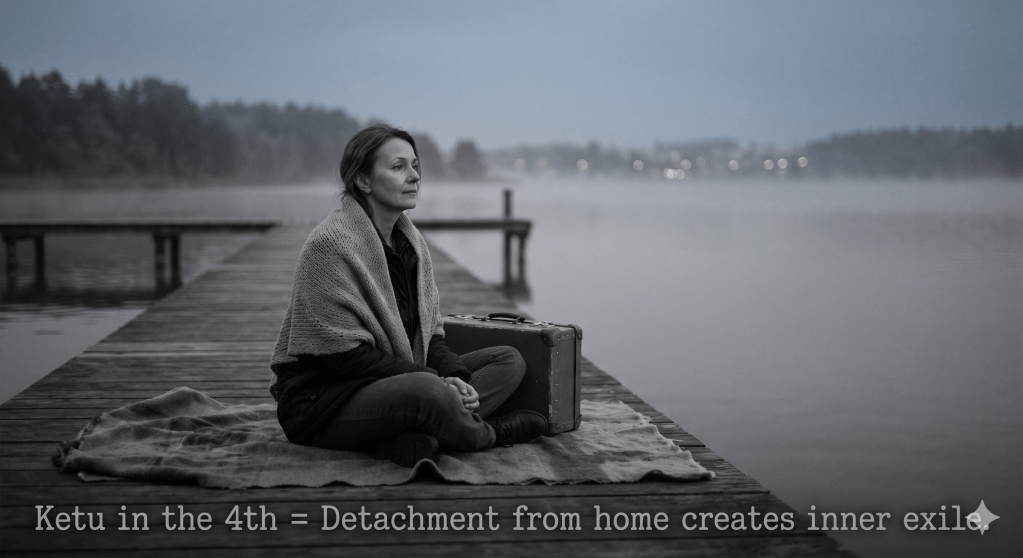
Ketu in the 4th house has a habit of exposing uncomfortable truths’. Especially about home.
Most people spend their lives chasing security. A house. A family name. A piece of land. A place they can call their own. Then Ketu arrives and asks a simple question: Own? For how long?
The Garuda Purana repeatedly reminds us that everything claimed as “mine” eventually belongs to time. The house remains. The owner leaves. The family gathers. Then generations scatter. Yet human beings continue acting as if permanence has signed a legal agreement with them.
This is where Ketu becomes inconvenient.
A person with Ketu in the 4th house often discovers early that home is not as solid as people imagine. Sometimes through separation. Sometimes through relocation. Sometimes through a strange inability to feel emotionally settled even when everything appears normal. The address exists. The belonging does not.
Others may look at them and say, “But you have a good family.” That may be true. The irony is that Ketu is rarely concerned with appearances. It is concerned with attachment. One can be surrounded by relatives and still feel like a temporary guest at a gathering that began before them and will continue after them.
The deeper issue is not the loss of home. It is the loss of certainty about what home actually means.
Most people assume emotional security comes from familiar surroundings. Ketu quietly dismantles that belief. A bigger house does not solve it. More possessions do not solve it. More family approval does not solve it. The person keeps arriving at the same realization. Comfort and peace are not identical.
There is something almost sarcastic about this placement. Society spends decades teaching people to build roots. Ketu spends decades asking whether those roots were ever permanent in the first place.
This can create an inner exile. Not because life is necessarily harsh, but because illusions become difficult to maintain. The individual notices how quickly relationships change. How memories fade. How family structures evolve. How even the places that shaped childhood eventually become unrecognizable.
The Garuda Purana would not find this surprising. Everything in the material world is passing through. Yet humans behave as though temporary arrangements are eternal truths. Ketu refuses to participate in that misunderstanding.
Over time, the search for belonging takes a different direction. The person stops expecting lasting fulfillment from external structures alone. The attention shifts inward. Not out of idealism, but out of observation. Experience keeps proving the same lesson.
Ketu in the 4th house does not necessarily deny family, property, or happiness’. It simply removes the illusion that these things can provide permanent refuge. What remains is a more difficult question. If every outer shelter is temporary, where is the one place that cannot be taken away?
That question becomes the real home.
And unlike houses, families, titles, and memories, it is the only one that survives every departure.
 ©NAVAGRA - A FREE VEDIC HOROSCOPE READING PLACE
Leave a comment