
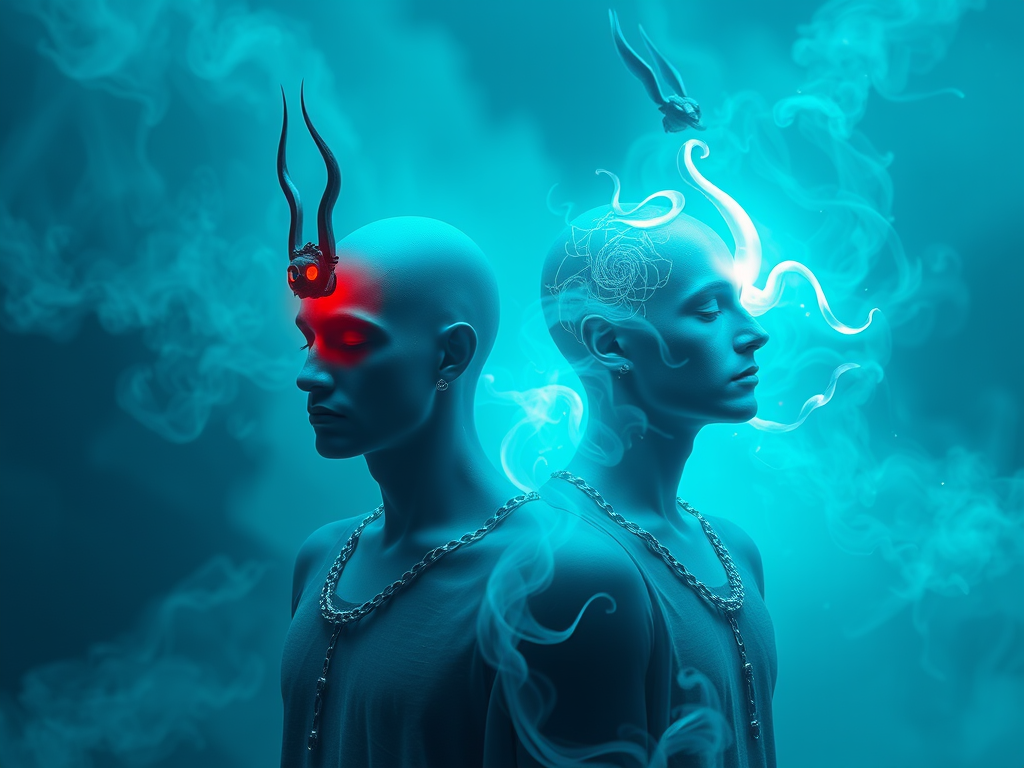
Rahu in the 1st and Ketu in the 7th pulls the soul into a quiet storm. The self stands in sharp focus, magnified beyond comfort. Identity feels inflated, urgent, like a question that never rests. Attention turns inward, almost obsessively. Every interaction becomes a mirror, reflecting not the other, but the self.
Relationships, then, grow distant. Not in absence, but in essence. Others appear close, yet remain unreachable—like images behind glass. Something essential fails to connect. The warmth of intimacy flickers, but never settles. Bonds form quickly, dissolve quietly. People come and go, leaving the same question behind: “Why does this still feel empty?”
There’s a hunger for validation, but it rarely satisfies. Commitment weighs heavy, not from lack of love, but from fear of dissolving into someone else’s world. The soul holds tightly to its own shape, resisting the blur that closeness can bring. The result is a cycle—approach, retreat, repeat.
Ketu in the 7th brings the ghosts. Past-life attachments echo. Unspoken regrets drift through every encounter. Sometimes, the other person feels uncannily familiar. Sometimes, they feel like a lesson wearing skin. The soul remembers betrayals, sacrifices, the blur of boundaries. It hesitates now. It protects itself—maybe too well.
This axis demands a reckoning. It calls for integration, not escape. To learn that the self is not lost in connection, and that real union begins when the self no longer fears being seen. But the road there is long. It winds through solitude, reflection, and a quiet unlearning.
In the end, it’s not about choosing self over other, or other over self. It’s about seeing both clearly—without distortion. And learning that true connection does not erase identity, but deepens it. Still, the journey is solitary. Not for lack of love, but because the soul must first find itself before it can truly find another.
 ©NAVAGRA - A FREE VEDIC HOROSCOPE READING PLACE
Leave a comment